
Extending Battery Life Through Gentle Cycling
Alex Frost, Winter Sun Solar & Battery
The short version
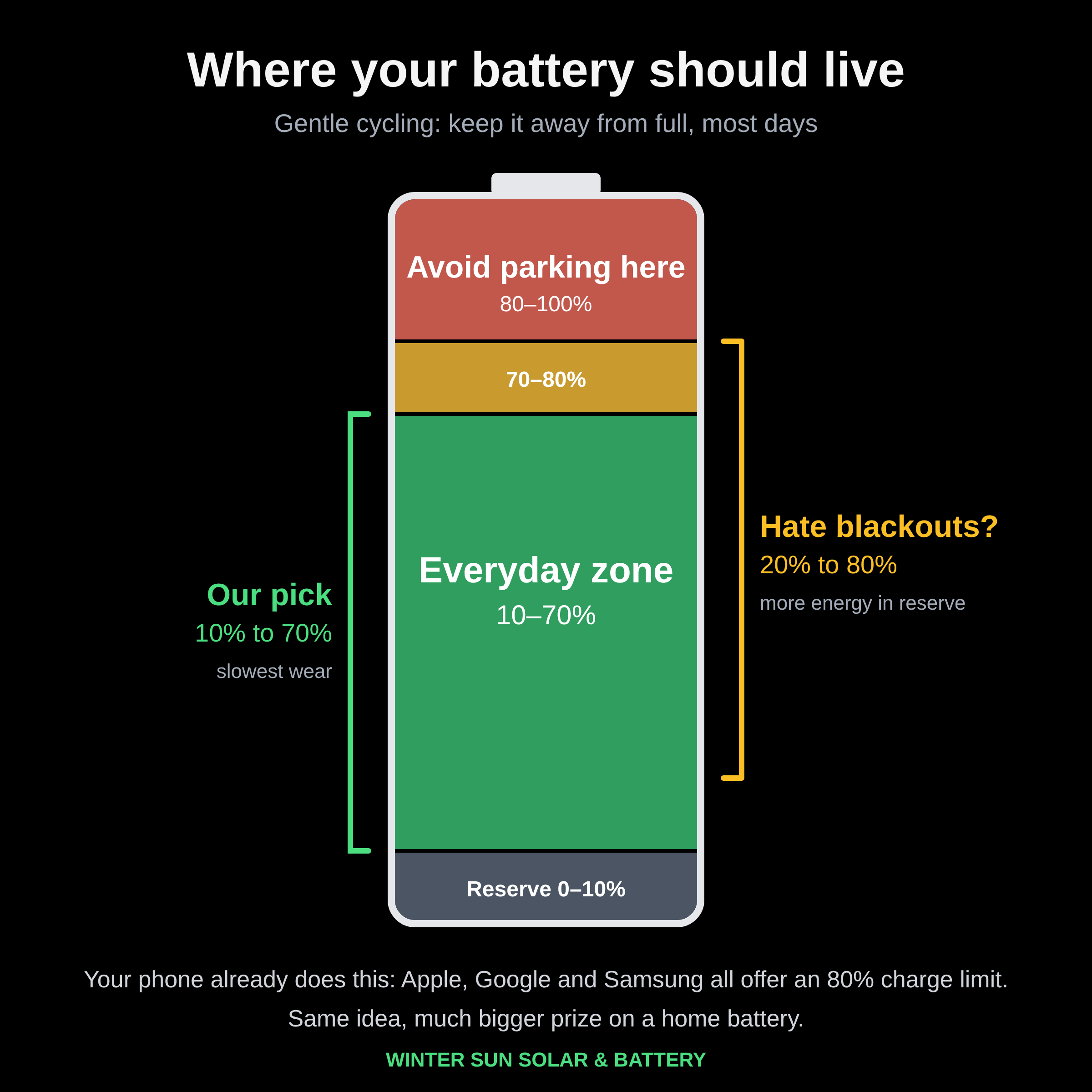
Phone makers have worked this out too. Apple, Google and Samsung all build a setting into their newer phones that caps charging at 80%, purely to make the battery last longer. A home battery follows the same principle, with a much bigger prize.
A battery's best years are the free ones: the years after it has paid for itself and earned more than the same money would have elsewhere. Gentle cycling is how I design systems to get more of them. If you already own a battery, you can borrow most of the trick.
You may have heard of the 20/80 rule: keep your battery between 20% and 80% charge. It works because lithium iron phosphate (LFP) batteries wear slowest when they spend little time full. For a home battery I go a step further and recommend about 10% to 70%, which makes it wear more slowly and adds years to its life. If you hate blackouts, stay with 20/80, because it holds more energy in reserve.
The catch is that whatever you don't use just sits there. If your battery is sized tightly to your evening use, a strict 10–70 can cost a few hundred dollars a year in extra grid imports. If it's oversized, the cost can be close to nothing. So work out your own number first, and tighten only while you're not falling short.
Why batteries wear out
Three things age an LFP battery: how full it sits, how hot it runs, and how hard it's worked. Two terms help here. State of charge (SoC) is how full the battery is, the percentage in your app. Depth of discharge (DoD) is how much of it you use in each cycle.
How full it sits. In lab testing, cells kept at a lower charge faded slowest. Ranked best to worst: 0–25%, 0–60%, 0–80%, 0–100%, then 75–100%. After about 2,500 hours the best cells kept 97% of their capacity and the worst kept 76%. Average SoC mattered more than DoD.
Heat. Hot cells age faster. In lab testing, cells held at 55°C faded 15–50% faster than cells at 40°C.
Hard work. Fast charging and discharging create heat and stress. Stay within your battery's rated current.
The maximum charge does most of the work, because it keeps the battery away from full. The minimum charge is mainly there to protect your backup power.
How to do it
Gentle cycling means the battery lives in the middle of its range and spends little time full. In practice:
Set a minimum charge of about 10%. That's the lowest the battery will discharge to. Apps often call it backup reserve or minimum reserve. Reserves are usually set between 10% and 30%, and if blackouts worry you, keep at least 2 kWh in reserve.
Set a maximum charge of 70% (or the nearest step your system allows). This is where most of the wear saving comes from. The 70% means 70% of the cells' total capacity, not of the usable capacity. Many apps show a percentage of usable capacity, so the matching setting is slightly higher: about 70% × total kWh ÷ usable kWh. For example, 15 kWh total and 13.5 kWh usable gives about 78%.
Let the sun do the charging. Avoid topping up from the grid to full, especially on hot days.
Skip full-charge modes you don't need. Some systems raise the reserve to 100% for storm backup. Switch it off once the storm has passed.
Check your manual for recalibration advice. Some manufacturers want an occasional full charge so the charge reading stays accurate. Follow theirs.
In summer a solar home often has the battery full by early afternoon, and it then sits at the top for hours. A lower maximum charge shortens that time. You aren't changing how you use power, only the top and bottom limits.
What it costs on your bill
A narrower range only costs you money when your home would have used the energy you're now leaving in the battery. If your overnight use already fits, the cost is $0. If it doesn't, each kWh a day you fall short costs about $110 a year, assuming a $0.30 per kWh gap between the grid price and what you'd earn by exporting ($73 at $0.20, $146 at $0.40). Use the rates on your own bill.
Is it worth it? Compare that cost with the value of a longer-lived battery. A battery that costs $8,000 works out at $667 a year over 12 years and $533 a year over 15. That's a saving of about $133 a year if gentle cycling buys three extra years, or about $222 a year for six. Those extra years are the free energy years: the battery has already paid for itself, so the savings keep coming.
Rule of thumb: start with 10–90. Tighten towards 10–70 only while your shortfall stays at or near zero.
Setting it up
Open your battery's app and look for two settings. The minimum charge is usually called backup reserve or minimum reserve, and almost every brand has it. The maximum charge is harder to find, because many owner apps don't offer one. If yours doesn't, ask your installer whether one can be set. Check your manual for the exact menu names.
Before you change anything:
Check your warranty. Changing reserve levels can affect warranty terms. Look for a minimum or maximum charge condition in yours.
Check your electricity plan. If you're on a virtual power plant (VPP) plan that pays you for discharging, ask the provider how it treats your reserve. It may control the battery within your limits.
Keep backup in mind. A 10% minimum charge on a 10 kWh battery keeps 1 kWh for a blackout, against 2 kWh at 20%. If you hate blackouts, or outages are common where you live, raise it to 20% and stick with 20/80.
Change one thing at a time, then watch your usage for a week or two before tightening further.
Keep it cool, and other habits
Heat is the second lever, and in South Australian summers it matters. Long periods above 45°C are especially damaging.
Shade and airflow. Keep the battery out of direct sun, off hot west-facing walls and clear of anything that traps heat. Check your manual for the allowed operating temperature.
Stay within rated power. Avoid running many big loads on the battery at once if your system struggles.
Long shutdowns. If you ever switch a battery off for a long period, store it at roughly 40–60% charge, not full. Check your manufacturer's advice first.
Check the app now and then. Temperature warnings are worth raising with your installer.
Questions people ask
Will this void my warranty?
It can. Warranties sometimes set minimum or maximum charge conditions, and changing reserve levels can affect them. Read yours, or ask the installer to confirm in writing.
Does gentle cycling really extend battery life?
Yes. The research consistently shows that the lower a battery's average charge, the slower it fades, and the biggest gain comes from not letting it sit full.
Does this apply to every battery?
The research is on LFP, the chemistry in many home batteries. Check your datasheet for your chemistry, and follow your manufacturer's advice if it differs.
What if my battery is oversized?
Then a tighter range may cost you nothing, because your evening use already fits inside it.
Will I run out of power in a blackout?
The minimum charge is held back for exactly this. At 10% it holds back less than at 20%, so if blackouts are common where you live, raise it and stick with 20/80.